

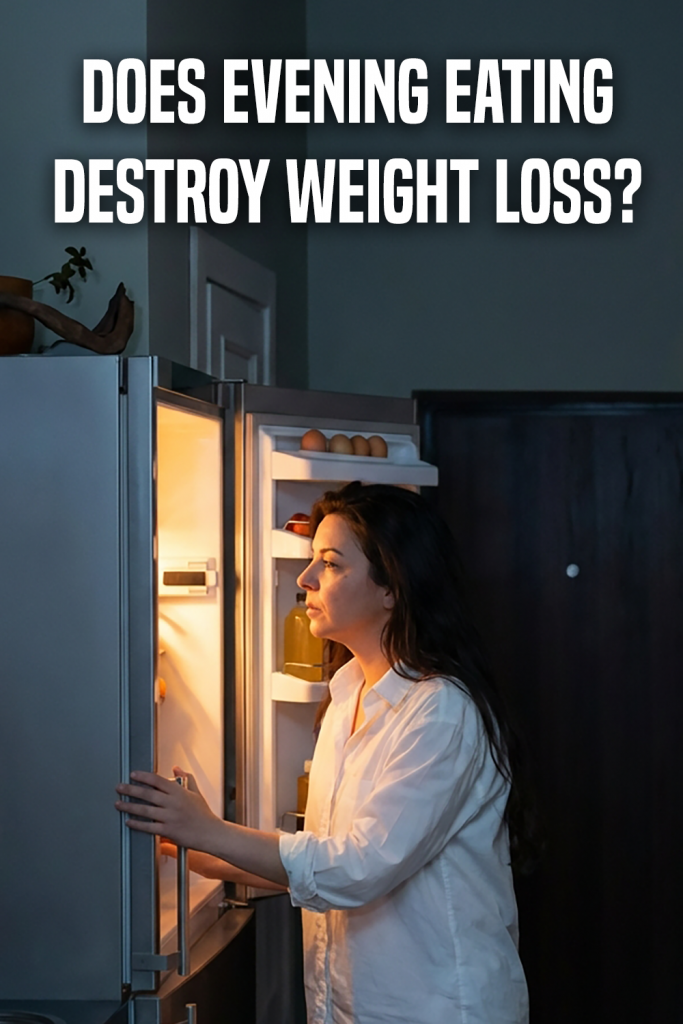
Does Evening Eating Destroy Weight Loss?
February 9, 2026Does Evening Eating Destroy Weight Loss?
There is increasing attention to the concern that meal timing can affect weight loss progress. You may have heard that evening eating can slow or ruin weight loss progress. It is purported that the time one eats can affect energy utilization, but we must consider the fundamentals of weight loss as well as factors that affect our individual rate of weight loss. Recent research indicates there may not be a precise answer to this question.
Basics of Weight Loss
In order to lose weight, you must be in a caloric deficit. This means that you must consume fewer calories than your body burns. The calories, or energy, we receive come from food and beverages. Finding the right balance of nutrients is imperative to promote weight loss.
Calorie-containing nutrients are known as macronutrients, which include protein, carbohydrates, and fats. Non-calorie-containing nutrients are known as micronutrients and include vitamins and minerals. Those seeking to lose weight must focus on macronutrients, as these contribute to overall calorie intake. It is recommended to limit the amount of calorie-containing beverages you drink throughout the day so that the majority of calories come from the foods you eat.
Our body burns calories in a few different ways:
- Thermic effect of food. After we eat a meal, the body expends energy to digest and absorb food. This makes up 10% of total energy expenditure.
- Non-exercise activity thermogenesis (NEAT). NEAT is the energy burned through everyday movements such as breathing, walking, or standing. Your body automatically uses energy for these tasks.
- Resting metabolic rate (RMR). RMR is the amount of calories your body needs for passive functions such as beating your heart or pumping your lungs.
- Exercise. Exercise is any purposeful activity that requires energy exertion. This is different from NEAT because you choose to participate in these activities.
Factors that Affect Weight Loss
When it comes to weight loss, there are many factors at play that can affect the rate at which we lose weight. With calorie restriction alone, a healthy rate of weight loss for individuals with a BMI of 27-35 is 0.5-1 pound per week. For those with a BMI greater than 35, a total of one to two pounds per week is appropriate.¹ The factors below contribute to overall weight loss.
1.
Hormones
The body produces a variety of gut hormones that regulate appetite and satiety. Leptin, glucose-like peptide 1 (GLP-1), and glucose-dependent insulinotropic polypeptide (GIP) are hormones that promote fullness.² Ghrelin is a hormone that promotes hunger. An imbalance of these hormones can cause elevated hunger and lead to eating more calories throughout the day.
2.
Medications
Medication use may result in weight gain. Specifically, antipsychotics, antidepressants, antiepileptics, steroids, and some antidiabetic drugs may cause weight gain.³.
3.
Genetics
Our genes can also influence our weight. It has been shown that genes can affect the number and size of fat cells in the body, body fat distribution, and resting metabolic rate.¹.
4.
Sleep
Sleep. It is thought that inadequate sleep can influence food intake and appetite regulation; however, the science is inconclusive. Several studies on the effect of sleep deprivation indicate changes in leptin and ghrelin, while other studies have shown no effect on hormone levels.⁴.
5.
Microbiome
Newer research indicates gut microbiota may have a larger impact on weight than originally thought. Research demonstrates that microbiome dysbiosis (an imbalance in microorganisms that live in the gut) can affect energy absorption, appetite, fat storage, and inflammation.⁵.
What the Research Says
There are mixed messages in current research regarding meal timing and weight loss. Some studies have shown that eating a heavier breakfast may support weight loss by increasing satiety, therefore reducing calorie intake throughout the day. In a meta-analysis by (Young et al) data showed that five out of nine studies found higher weight loss in participants who consumed a greater amount of calories earlier in the day. One randomized controlled trial looked at the difference between morning-loaded (ML) and evening-loaded (EL) weight loss while in a calorie deficit. Results showed no significant difference in weight loss between groups. Participants who ate a higher-calorie breakfast and participants who ate a higher-calorie evening meal both lost weight.⁶ There is a lack of concrete evidence to say if morning-loaded eating or evening-loaded eating results in greater weight loss when in a caloric deficit. However, meal timing may affect other factors such as appetite and hormone secretion, ultimately leading to a change in calorie intake.⁷
Resources
- Raymond, Janice; Morrow, Kelly. Food & The Nutrition Care Process. 15th ed, Elsevier, 2021
- Hong, So-hyeona; Choi, Kyung Mookb. Gut hormones and appetite regulation. Current Opinion in Endocrinology & Diabetes and Obesity 31(3):p 115-121, June 2024. | DOI: 10.1097/MED.0000000000000859
- Singh, Sneha et al. “Pharmacogenomics of Medication-Induced Weight Gain and Antiobesity Medications.” Obesity (Silver Spring, Md.) vol. 29,2 (2021): 265-273. doi:10.1002/oby.23068
- Liu, Shuailing et al. “Sleep Deprivation and Central Appetite Regulation.” Nutrients vol. 14,24 5196. 7 Dec. 2022, doi:10.3390/nu14245196
- Liu, Bing-Nan et al. “Gut microbiota in obesity.” World journal of gastroenterology vol. 27,25 (2021): 3837-3850. doi:10.3748/wjg.v27.i25.3837
- Ruddick-Collins, Leonie C et al. “Timing of daily calorie loading affects appetite and hunger responses without changes in energy metabolism in healthy subjects with obesity.” Cell metabolism vol. 34,10 (2022): 1472-1485.e6. doi:10.1016/j.cmet.2022.08.001
- Flanagan, Alan. “Is the timing of eating relevant for weight loss?.” The Proceedings of the Nutrition Society, 1-9. 10 Jan. 2025, doi:10.1017/S0029665124007547
Nikki Santillo, MS, RD, CD-N, is a registered dietician at Middlesex Health Center for Medical and Surgical Weight Loss.
 | ABOUT THE AUTHOR Nikki Santillo, MS, RD, CD-N, is a registered dietician at Middlesex Health Center for Medical and Surgical Weight Loss. She earned a BS in Nutritional Science and an MS in Health Promotion Sciences and completed her dietetic internship at the University of Connecticut. Nikki is a program dietitian who provides nutrition counseling to patients interested in metabolic surgery and/or medical weight loss. |


